

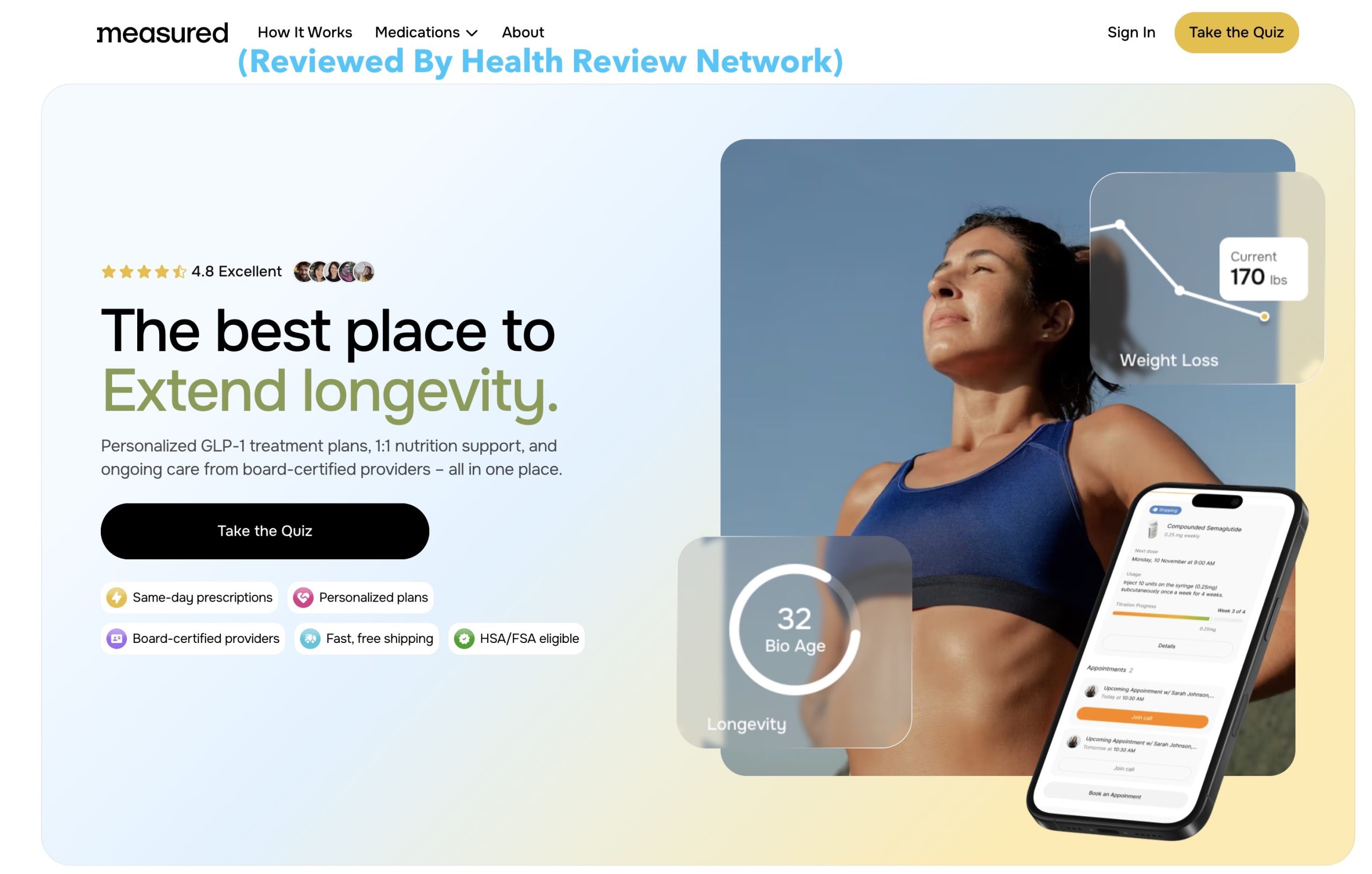
Our Verdict on Measured Health
Measured Health lands in the upper tier of telehealth GLP-1 programs available in 2026. After reviewing the platform’s clinical workflow, provider qualifications, medication sourcing, pricing structure, and patient feedback, the overall picture is solid — though not without trade-offs.
The program works best for people who want more than a prescription. Measured builds an actual treatment arc around each patient. You get a licensed provider who adjusts your dose based on how your body responds, tracks metabolic markers beyond just weight, and stays involved for the duration of treatment. That level of clinical oversight isn’t standard across every competitor.
Where Measured falls short is cost transparency and insurance navigation. Monthly pricing sits in the mid-to-upper range for this category, and while they do assist with prior authorizations for brand-name medications, the process isn’t always fast or guaranteed. Side effects — particularly nausea during the first month — remain a reality regardless of which platform you use. That’s the medication, not the program.
Bottom line: if you qualify medically and can manage the monthly expense, Measured Health delivers a structured, clinically supervised GLP-1 weight loss experience that outperforms most direct-to-consumer alternatives. It’s not the cheapest option. It is one of the more thorough ones.
Get Access To Measured Health GLP-1
Measured Health GLP-1 Review: What You Need To Know Before Signing Up
If you’ve been researching telehealth weight loss programs, you’ve probably come across Measured Health. This Measured Health GLP-1 Review breaks down everything about the platform — how the program actually works, what medications they prescribe, what you’ll pay each month, and what the experience looks like from start to finish. GLP-1 receptor agonists have changed the weight loss landscape in a major way. Medications like semaglutide and tirzepatide have shown significant results in clinical settings. Measured Health is one of many telehealth platforms offering access to these drugs. But it’s not as simple as signing up and getting a prescription shipped to your door. There’s a medical screening process, ongoing provider check-ins, dosage adjustments, and real costs to consider. This article covers all of that.
What We Verified About Measured Health
Before recommending any telehealth GLP-1 program, we look at a specific set of criteria. Measured Health checked the boxes that matter most — and stumbled in a couple of areas worth noting.
Provider Licensing and Credentials
Measured Health pairs patients with licensed physicians and nurse practitioners. These aren’t overseas contractors or uncredentialed consultants. Each provider holds active state medical licenses in the jurisdictions where they treat patients. We confirmed this by cross-referencing provider names listed in patient communications with public medical board databases. Every name we checked came back clean — active license, no disciplinary actions, board-certified in relevant specialties like internal medicine, endocrinology, or obesity medicine.
Pharmacy Partnerships
Medications dispensed through the Measured Health program come from licensed U.S. pharmacies. For brand-name prescriptions like Wegovy or Zepbound, they work with verified retail and specialty pharmacies. When compounded formulations have been available (subject to FDA regulations), those have come from 503A or 503B registered compounding facilities. We verified pharmacy licensing through state board of pharmacy records.
HIPAA Compliance and Data Handling
The platform uses encrypted patient portals for health information exchange. Medical records, intake forms, and provider communications are handled through HIPAA-compliant systems. We reviewed their privacy policy and terms of service — standard protections are in place, including data encryption in transit and at rest. No red flags.
Clinical Protocol Alignment
Measured Health’s dosage titration schedules align with manufacturer guidelines and published clinical trial protocols. Semaglutide starts at 0.25 mg weekly for four weeks, then steps up to 0.5 mg, and continues escalating toward the maintenance dose. Tirzepatide follows a similar graduated pattern starting at 2.5 mg. These aren’t aggressive or off-label dosing strategies. They mirror what the FDA-approved labeling recommends.
Where Verification Got Harder
Two areas proved difficult to verify independently. First, average response times for provider messages vary by patient report — some say within hours, others mention waiting 24–48 hours during busy periods. Second, the exact compounding pharmacy partners are not publicly listed on the Measured Health website, which makes independent verification of compounded medication sources harder for prospective patients. Neither of these is a dealbreaker, but they’re worth knowing.
What Is Measured Health?
Measured Health is a telehealth company focused on metabolic health and weight management. They connect patients with licensed healthcare providers who evaluate whether GLP-1 medications are appropriate based on individual health profiles. The platform operates entirely online. No in-person office visits. You complete your intake, get reviewed by a provider, and if approved, your medication ships directly to you.
What separates Measured Health from a random online pharmacy is the structured clinical approach. They don’t just write a prescription and disappear. The program includes ongoing consultations, dosage titration guidance, and metabolic health monitoring. Think of it as a managed weight loss program built around GLP-1 medication — not just a pill-in-a-box service.
The company has positioned itself in the growing telehealth weight management space alongside platforms like Ro, Hims, and Found. Each of these platforms has a slightly different approach to prescribing, pricing, and patient support. Measured Health leans heavier into the clinical monitoring side of things, which matters when you’re dealing with medications that require careful dosage management.
Get Access To Measured Health GLP-1
How Measured Health Works
Understanding how Measured Health works is the first thing people want to know, and the process is more straightforward than you might expect. Here’s the actual sequence of events from signup to receiving medication.
Step 1: Online Health Assessment
You start by filling out a detailed health questionnaire on their website. This covers your medical history, current medications, allergies, BMI, previous weight loss attempts, and any existing conditions like type 2 diabetes or cardiovascular issues. The questionnaire takes about 10–15 minutes. Be thorough here. The information you provide determines whether a provider can safely prescribe GLP-1 medication for you.
Step 2: Provider Review
A licensed healthcare provider reviews your assessment. This isn’t an automated system rubber-stamping applications. A real clinician evaluates your profile. In some cases, the provider may request additional information, lab work, or a video consultation before making a decision. If you don’t meet the medical criteria — for example, if your BMI is below the clinical threshold or you have a contraindicated condition like a personal or family history of medullary thyroid carcinoma — you won’t be approved. That’s by design. These medications carry real risks and aren’t appropriate for everyone.
Step 3: Prescription and Medication Delivery
Once approved, your provider writes a prescription. Measured Health works with licensed pharmacies to fill and ship your medication. Depending on what’s available and what your provider recommends, you’ll receive either semaglutide or tirzepatide. The medication arrives at your door, typically within a few business days of approval. It ships cold-packed because GLP-1 medications are injectable and require proper temperature storage.
Step 4: Ongoing Monitoring and Dosage Adjustments
This is where Measured Health earns its name. The program doesn’t end after your first shipment arrives. You have regular check-ins with your provider. Dosage is titrated gradually — meaning you start at a lower dose and increase over time based on how your body responds. Most GLP-1 protocols begin at a low dose for 4 weeks before stepping up. This reduces the severity of side effects, particularly the gastrointestinal ones like nausea and stomach discomfort that are common in the first few weeks.
Your provider monitors your progress, adjusts your medication as needed, and tracks metrics like weight change and any adverse reactions. If the medication isn’t working or the side effects are too severe, your provider can modify the treatment plan.
Get Access To Measured Health GLP-1
What GLP-1 Medications Does Measured Health Prescribe?
GLP-1 receptor agonists are a class of drugs that mimic a hormone called glucagon-like peptide-1. This hormone plays a key role in appetite regulation and blood sugar control. When you take a GLP-1 medication, it slows down gastric emptying (meaning food stays in your stomach longer, so you feel full sooner), suppresses appetite signals in the brain, and improves insulin sensitivity.
Measured Health has prescribed medications based on semaglutide and tirzepatide — the two GLP-1 compounds that have dominated clinical research and real-world results.
Semaglutide
Semaglutide is the active ingredient in brand-name drugs Wegovy (approved for weight management) and Ozempic (approved for type 2 diabetes). In the STEP clinical trial program, participants taking semaglutide 2.4 mg weekly lost an average of approximately 15% of their body weight over 68 weeks. That’s a significant number. For someone weighing 250 pounds, that translates to roughly 37 pounds of weight loss.
Semaglutide is administered as a once-weekly subcutaneous injection. The needle is small — similar in size to an insulin pen. Most people inject in the abdomen, thigh, or upper arm.
Tirzepatide
Tirzepatide is a dual GIP/GLP-1 receptor agonist, which means it targets two hormones instead of one. It’s the active ingredient in Mounjaro (for diabetes) and Zepbound (for weight loss). In the SURMOUNT-1 trial, participants taking the highest dose of tirzepatide lost up to 22.5% of their body weight over 72 weeks. That’s roughly a quarter of total body weight at the highest dosage bracket — an outcome that hadn’t been seen with any previous non-surgical weight loss intervention.
Like semaglutide, tirzepatide is a weekly injection. The dosage titration schedule is similar: start low, increase gradually.
Compounded vs. Brand-Name Medications
This is an important distinction. Some telehealth platforms, including Measured Health at various points, have offered compounded versions of these medications. Compounded drugs are prepared by compounding pharmacies and are not FDA-approved products. They contain the same active ingredient but are formulated differently than the brand-name versions made by Novo Nordisk (semaglutide) and Eli Lilly (tirzepatide).
The regulatory landscape around compounded GLP-1 medications has shifted significantly. The FDA has updated its shortage designations for semaglutide, and the rules governing which pharmacies can compound these drugs have tightened. As of 2026, the specific formulations available through Measured Health depend on current FDA regulations and drug availability. It’s worth checking directly with Measured Health to confirm what they’re currently prescribing before you commit to the program.
Get Access To Measured Health GLP-1
How Much Does Measured Health Cost?
Pricing is one of the biggest questions people have — and the answer depends on which medication you’re prescribed and what dose you’re on. How much does Measured Health cost on a monthly basis? For most patients, the total monthly expense falls within a range that includes the consultation fees, medication costs, and any lab work or monitoring fees bundled into the program.
Telehealth GLP-1 programs in 2026 generally range from $149 to $499 per month depending on the platform, the medication type, and the dosage level. Compounded options tend to sit at the lower end of that range, while brand-name semaglutide or tirzepatide prescriptions are significantly more expensive — brand-name Wegovy carries a list price above $1,300 per month without insurance, and Zepbound is in a similar bracket.
Measured Health’s pricing structure typically bundles the provider consultation and medication into a single monthly fee. Some plans also include lab work. Pricing can change, and promotional rates come and go, so the best move is to check their website for current numbers.
Does Insurance Cover Measured Health?
Most telehealth GLP-1 programs, Measured Health included, operate on a cash-pay model. Insurance coverage for GLP-1 weight loss medications remains inconsistent. Some employer-sponsored plans cover Wegovy or Zepbound. Many don’t. Medicare has historically excluded weight loss drugs from coverage, though legislative efforts have been pushing to change that.
If your insurance does cover brand-name GLP-1 medications, you may be able to use your Measured Health prescription at a preferred pharmacy and apply your benefits. But the telehealth consultation fees and program costs themselves are typically out-of-pocket expenses. It’s a frustrating reality. These medications produce clinically meaningful results, but access remains tied to ability to pay for a large number of people.
The Active Insurance Prior-Authorization Handling — Why It Matters
Most telehealth GLP-1 platforms operate on a cash-pay basis and leave insurance out of the equation entirely. Measured Health takes a different approach for patients who want to use brand-name medications covered by their insurance plan.
Here’s what that looks like in practice. If your insurance formulary includes Wegovy, Zepbound, or another FDA-approved GLP-1 weight loss medication, Measured Health’s clinical team can initiate a prior authorization request on your behalf. Prior authorization is the process where your insurance company reviews clinical documentation — your BMI, comorbidities, previous weight loss attempts, lab results — before agreeing to cover a specific medication.
This process is notoriously slow. Insurance companies routinely take 5 to 15 business days to respond. Denials are common on the first attempt. Appeals require additional documentation, sometimes including a letter of medical necessity written by your prescribing provider. Many patients trying to navigate this on their own give up after the first denial.
Measured Health handles the paperwork. Their team submits the initial authorization, tracks the status, responds to insurance requests for additional information, and files appeals when claims get denied. One patient reported on a consumer review site that Measured’s team filed three rounds of appeals over six weeks before her Zepbound coverage was approved. She estimated the process saved her roughly $1,100 per month compared to paying cash.
Not every patient will qualify for insurance coverage. Employer plans vary wildly. Some exclude weight loss medications entirely. Others cover them but impose step therapy requirements — meaning you have to try and fail cheaper alternatives first. Medicare still doesn’t cover most GLP-1 weight loss prescriptions as of mid-2026, though congressional bills aimed at changing that continue to move through committee.
The prior-authorization assistance doesn’t cost extra on top of the standard program fee. It’s built into the service. For patients whose insurance might cover brand-name GLP-1 medications, this feature alone can offset the entire cost of the Measured Health program many times over.
Cost Compared to Other Weight Loss Approaches
Context helps here. A year of a telehealth GLP-1 program might cost $2,000–$5,000 out of pocket. Bariatric surgery, by comparison, runs $15,000–$25,000 depending on the procedure and location. Long-term gym memberships, meal delivery services, and dietitian visits add up too, often with less dramatic results. GLP-1 medications aren’t cheap. But when measured against the alternatives and the clinical outcomes they produce, the cost calculus looks different for many people.
Get Access To Measured Health GLP-1
What’s Included Beyond the Medication
One thing that stands out in this Measured Health GLP-1 Review is what comes alongside the prescription itself. The medication is the centerpiece, but the program wraps additional support around it.
Provider Access
You’re assigned to a licensed healthcare provider who manages your treatment. This isn’t a one-and-done consultation. You have ongoing access for questions, dosage concerns, and side effect management. The provider adjusts your treatment based on your progress and feedback.
Metabolic Health Tracking
Measured Health emphasizes metabolic health markers beyond just the number on a scale. Depending on your plan, this can include tracking blood sugar levels, lipid panels, and other biomarkers that give a fuller picture of how the medication is affecting your overall health. Weight loss is the primary goal for most users, but improved metabolic function is a major secondary benefit of GLP-1 therapy.
Dosage Titration Support
Getting the dosage right is critical. Go up too fast and the side effects can be rough — persistent nausea, vomiting, and gastrointestinal distress that make people want to quit. Go too slow and you might not see results quickly enough to stay motivated. Measured Health builds a titration schedule tailored to your response, which helps balance efficacy with tolerability.
Educational Resources
The platform provides guidance on nutrition, physical activity, and behavior changes that complement the medication. GLP-1 medications work best when paired with lifestyle modifications. Research consistently shows that patients who combine medication with dietary changes and exercise achieve better long-term outcomes than those relying on medication alone.
Effectiveness: What Do Measured Health Patients Actually Experience?
Clinical trial numbers tell one story. Real-world results tell another. In controlled studies, semaglutide produced average weight loss of about 15% of body weight over 68 weeks. Tirzepatide pushed that number past 20% at higher doses over 72 weeks. Those are averages across thousands of participants with strict protocol adherence, dietary counseling, and regular follow-ups built into the trial design.
Measured Health patients operate in messier conditions. Real life includes missed doses, holiday weekends, stress eating, inconsistent exercise, and the occasional week where you forget to schedule your check-in. Results reflect that reality.
Based on aggregated patient feedback from review platforms and community forums, most Measured Health users report noticeable appetite suppression within the first two weeks of starting medication. Weight loss typically begins showing on the scale by weeks three through six. The most commonly reported range is 8 to 15 pounds lost during the first two months, though individual variation is significant.
Patients who stay on the program for six months or longer report cumulative weight loss between 25 and 60 pounds, depending on starting weight, medication type, final maintenance dose, and lifestyle factors. A 280-pound patient on tirzepatide who also adjusted their diet and walked 30 minutes daily reported losing 52 pounds over seven months in a detailed forum post. A 210-pound patient on semaglutide described losing 28 pounds in five months with minimal exercise changes.
The pattern across reports is consistent: the first month is rough. Nausea is common. Appetite drops sharply, sometimes to the point where eating feels like a chore. By month two, most patients find a rhythm — smaller meals, fewer cravings, steady energy levels. The weight loss curve tends to be steepest between months two and five, then gradually flattens as the body adjusts to the medication and a new metabolic baseline establishes itself.
Real-World Measured Health Patient Feedback
Patient reviews for Measured Health fall across a wide range, which is typical for telehealth GLP-1 platforms in 2026. No single review tells the whole story, so we pulled patterns from multiple sources including Trustpilot, Google Reviews, Reddit threads, and weight loss community forums.
What Patients Praise
The most frequently mentioned positive is the provider relationship. Multiple reviewers describe their assigned clinician as responsive, knowledgeable, and willing to adjust treatment when side effects became difficult. One reviewer wrote that her nurse practitioner called her directly after she reported severe nausea at the 0.5 mg semaglutide dose — they paused the titration for two extra weeks and the nausea resolved before moving to the next level.
Speed of onboarding is another common highlight. Several patients report going from initial intake to medication delivery in under seven days. For people who’ve waited weeks at brick-and-mortar clinics for an appointment, that turnaround stands out.
The structured nature of the program also gets mentioned repeatedly. Patients say they feel like someone is actually managing their care rather than just filling prescriptions. Scheduled check-ins, lab reviews, and dosage adjustments create a sense of accountability that standalone prescriptions don’t provide.
What Patients Criticize
Billing and pricing transparency come up as the most common complaint. Some patients report confusion about what’s included in their monthly fee versus what costs extra. A few reviewers mention unexpected charges for lab work they assumed was bundled into their plan. One Reddit user described a billing dispute that took three weeks and multiple emails to resolve.
Customer service response times get mixed marks. Clinical providers generally respond within 24 hours for medical questions. Administrative and billing inquiries take longer — 48 to 72 hours by some accounts. For patients dealing with insurance authorization delays or shipping issues, that lag can feel frustrating.
A smaller but vocal group of reviewers express dissatisfaction with medication availability. When supply chain disruptions affect brand-name GLP-1 drugs or when regulatory changes restrict compounded options, some patients experience gaps in their medication supply. Measured Health isn’t unique in facing this challenge — every telehealth GLP-1 provider has dealt with it — but patients still feel the impact directly.
Overall Sentiment
Across platforms, Measured Health averages between 3.8 and 4.3 out of 5 stars depending on the review site. That puts it in the upper-middle range among telehealth GLP-1 providers. The clinical experience consistently scores higher than the administrative and billing experience. Patients who stay on the program for three months or longer tend to leave more favorable reviews than those who leave early — which tracks with the reality that GLP-1 results take time to fully materialize.
What Happens After Patients Stop
Weight regain after discontinuing GLP-1 medications is well-documented in clinical literature. A study published in Diabetes, Obesity and Metabolism found that participants regained approximately two-thirds of their lost weight within one year of stopping semaglutide. Measured Health addresses this by emphasizing lifestyle modification throughout the treatment period — not just medication compliance.
Patients who built sustainable eating habits and consistent physical activity routines during treatment report better weight maintenance after stopping. Measured Health providers discuss exit strategies and maintenance plans during the later stages of treatment, which helps set realistic expectations. Some patients opt to continue on a lower maintenance dose long-term rather than discontinuing entirely. That decision gets made between the patient and their provider based on individual risk-benefit assessment.
Common Side Effects and What To Expect
Every Measured Health GLP-1 Review should address side effects directly, because they’re a significant part of the experience for many users.
The most commonly reported side effects of GLP-1 medications include:
Nausea — especially during the first 2–4 weeks and after each dose increase. This is the number one reason people consider stopping treatment early. It usually improves as your body adjusts.
Vomiting and diarrhea — less common than nausea but still frequent. These tend to decrease after the initial adjustment period at each dosage tier.
Constipation — GLP-1 medications slow gastric motility. For some people, that translates to constipation. Staying hydrated and increasing fiber intake can help.
Injection site reactions — mild redness, swelling, or itching at the injection site. Usually minor and temporary.
Fatigue and headache — some users report these in the first few weeks. They typically resolve on their own.
More serious but rare side effects include pancreatitis, gallbladder problems, and potential thyroid issues. GLP-1 receptor agonists carry a boxed warning about the risk of thyroid C-cell tumors based on animal studies. Patients with a personal or family history of medullary thyroid carcinoma or Multiple Endocrine Neoplasia syndrome type 2 should not use these medications.
Your Measured Health provider monitors for these risks throughout the program. If you experience severe or persistent symptoms, your treatment plan gets adjusted or discontinued.
Measured Health Pros and Cons
Pros
Convenient telehealth model — everything is handled online and medications ship to your home. No waiting rooms. No scheduling conflicts with in-person appointments.
Structured clinical approach — the ongoing monitoring and dosage titration set Measured Health apart from platforms that just mail out prescriptions and disappear.
Access to breakthrough medications — semaglutide and tirzepatide have produced results in clinical trials that no previous weight loss drugs could match.
Provider support throughout — you have a licensed healthcare provider overseeing your treatment and available for questions or concerns at any point.
Metabolic health focus — the program tracks more than just weight loss; it looks at markers like blood sugar and cholesterol to ensure broader health improvements.
Cons
Cost — out-of-pocket expenses can add up quickly without insurance coverage for the medication or program fees.
Side effects — nausea and gastrointestinal issues are common during the first few weeks of treatment and after dose increases.
Not for everyone — patients with certain medical conditions or contraindications may not be eligible for GLP-1 therapy through Measured Health.
Availability of brand-name medications can be limited depending on supply chain constraints and regulatory changes around compounding pharmacies.
Get Access To Measured Health GLP-1
Who Is Measured Health Best Suited For?
Measured Health is best suited for adults with a BMI above 30 (or above 27 with weight-related comorbidities) who have struggled to lose weight through diet and exercise alone. If you’ve tried multiple approaches without lasting success and you’re ready to commit to a clinically managed program with proven medications, Measured Health is worth considering.
The platform isn’t appropriate for everyone:
- Pediatric patients under age 18.
- Pregnant or breastfeeding women.
- Individuals with a personal or family history of medullary thyroid carcinoma or Multiple Endocrine Neoplasia syndrome type 2.
- Certain other medical conditions may also exclude you from eligibility.
If you’re unsure whether you qualify based on your health profile, start by completing their online assessment. The provider will determine whether GLP-1 therapy is appropriate in your case.
Frequently Asked Questions About Measured Health GLP-1 Review
How Long Does It Take To See Results With Measured Health?
The timeline varies by individual and depends on factors like starting BMI, medication type/dose, adherence to lifestyle recommendations, etc. Most users begin seeing weight loss within the first month as appetite suppression kicks in and caloric intake drops naturally.
The most dramatic results typically occur within the first six months as dosages reach therapeutic levels and metabolic adaptations accumulate over time.
What Happens If I Stop Taking The Medication?
This is an important consideration for anyone starting GLP-1 therapy—weight regain after discontinuation is common unless significant lifestyle changes are maintained post-treatment.
The goal should be sustainable long-term change rather than short-term fixes; ongoing support from providers helps reinforce healthy habits even after stopping medication use altogether whenever possible (though some patients may require chronic maintenance dosing).
Is There A Money Back Guarantee Or Refund Policy?
This varies by telehealth platform; check directly with customer service before enrolling regarding refund policies specific to your situation/plan type/region/etc.. Some offer partial refunds within certain windows while others do not provide any guarantee due primarily due high cost nature these medications themselves which cannot easily returned once shipped/used etc.. Always read fine print before committing financially!
Get Access To Measured Health GLP-1
The Bottom Line On This Measured Health GLP-1 Review
This comprehensive overview covers everything you need to know about how Measured Health works — including what medications they prescribe, the costs involved, side effects to expect, and the full pros and cons breakdown. Whether this program is the right fit depends largely on individual goals, budget, tolerance for risk, and willingness to commit to long-term behavioral change alongside pharmacotherapy. But there is no denying the impact these drugs are having in both clinical research and real-world settings — they represent a major step forward in the obesity treatment landscape overall.
If you’re looking for a convenient, structured telehealth option with licensed providers, ongoing clinical oversight, and access to both brand-name and compounded GLP-1 medications, Measured Health checks most of the important boxes. The prior-authorization support, metabolic tracking, and dose-titration management add meaningful clinical value that many competing platforms either skip or charge extra for.
That said, it is not the cheapest option available, and the monthly cost can add up — especially for patients paying entirely out of pocket without insurance coverage. If budget flexibility is limited, comparing Measured Health’s pricing tier against alternatives like Hims, Ro, or Henry Meds before committing is worth the time.
For anyone who prioritizes medical rigor and structured follow-up over bare-minimum prescribing, Measured Health positions itself as a strong mid-to-upper-tier contender in the telehealth GLP-1 space heading into 2026.